
AssemblyAI
AssemblyAI: speech-to-text APIs for recorded and live audio
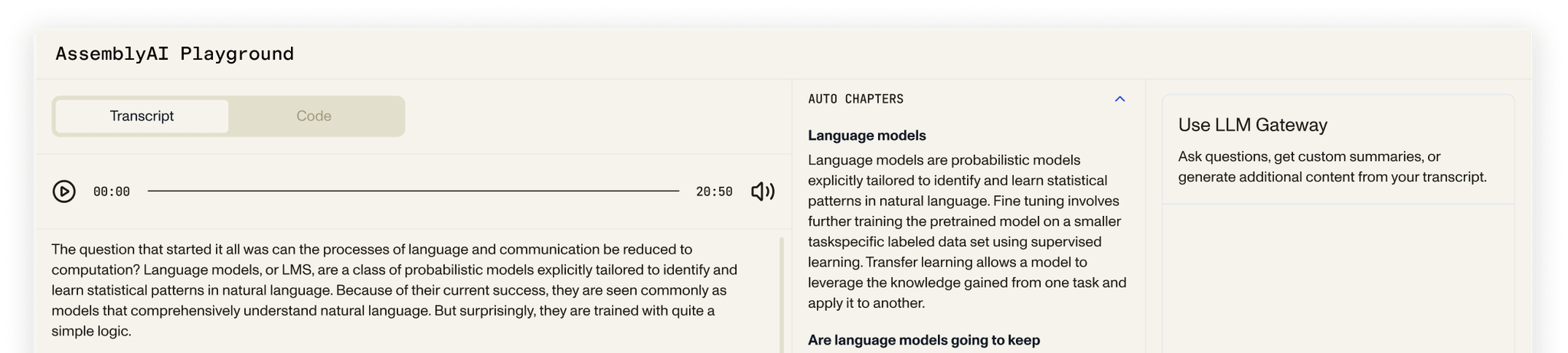
AssemblyAI provides speech-to-text APIs for recorded files, live audio and short synchronous clips. Developers can add speaker labels, word timestamps, subtitle exports and speech analysis to their own products. A browser playground helps explore the models; production use centers on API integration, with language coverage and pricing varying by model.
Free trial availableAccount required
- Access
- Free trial available
- Usage pricing
- USD 0.15 / 60 audio minutesUniversal-2 — recorded
- Available on
- Web, API
Transcription infrastructure for applications and voice products
AssemblyAI supplies transcription for applications, rather than a finished document-editing workspace. The recorded-file API processes interviews, calls and other recordings asynchronously. WebSocket streaming returns words during live audio, while Sync returns a finished short-clip transcript in one HTTP request. Python and TypeScript SDKs support integration, and the browser playground lets you explore the service before building around it.
Language coverage depends on the model: recorded Universal-2 supports 99 languages, while recorded Universal-3.5 Pro supports 18. For live audio, Universal-3.6 Pro Realtime supports 32 languages; Universal-Streaming Multilingual covers English, Spanish, German, French, Portuguese and Italian. A supported language on one endpoint does not establish support on every other endpoint.
Completed recorded jobs return structured results with word timestamps and optional speaker-labelled utterances. Export SRT or VTT subtitles through the API. The plain transcript text omits speaker labels and timestamps; use the utterance data to build a readable speaker-by-speaker transcript. Diarization separates voices, while identifying a speaker by name or role is a different Speech Understanding feature. Summaries, translation and LLM requests have additional charges.
Sync suits short voice messages and completed utterances up to two minutes long. It accepts WAV or raw PCM audio, with word timestamps enabled as an option; it does not ingest a remote file URL. Longer recordings use the asynchronous API, whose ten-hour limit is separate from Sync. Live transcription is billed for each open WebSocket connection, including silence, so leaving a connection open keeps accumulating charges.
The standard service processes audio in the cloud. Enterprise self-hosting covers specific Realtime and Sync APIs, with assisted deployment. On paid accounts, owners and admins can opt out of model improvement for future requests and set retention controls. Without a retention setting or BAA, deletion of recorded transcripts begins after 30 days; uploaded audio is normally deleted earlier. Deletion can take time, and logging and billing metadata follow separate retention rules. Opting out can enable zero audio and transcript retention for Streaming and Sync in production; that is separate from model-training eligibility and metadata retention.
Best for
- Developers adding transcription to applications
- Teams building live captions or voice interfaces
- Services processing recorded interviews at scale
Limitations
This is a developer API rather than a finished collaborative transcript editor. Language coverage, add-ons and limits vary by endpoint. Streaming bills open connections including idle time; multichannel jobs multiply recorded usage. Trial credits do not include a recurring free allowance, and paid training opt-out applies to subsequent requests.
AssemblyAI speech-to-text and developer features
Recorded-file transcription API
Process long recordings asynchronously with model-specific language support and word timestamps.
Live streaming transcription
Build live captions and voice interfaces over WebSocket; open connection time is billable.
Short-clip Sync API
Get a finished transcript in one HTTP request for WAV or raw PCM clips up to two minutes.
Speaker-labelled results
Add diarization to separate voices; identifying actual names or roles is a distinct analysis feature.
Subtitle and transcript endpoints
Export SRT/VTT subtitles or build speaker-formatted transcripts from structured utterance data.
Account data controls
Paid owners/admins can configure future-request training opt-out and retention; enterprise self-hosting covers specific APIs.
AssemblyAI pricing
Recorded transcription starts at USD 0.15 per audio hour with Universal-2 or USD 0.21 with Universal-3.5 Pro. Sync costs USD 0.30 per audio hour. Live transcription costs USD 0.15 per connection hour with Universal-Streaming or USD 0.45 with Universal-3.6 Pro Realtime, including idle time. Speaker diarization adds USD 0.02 per hour for recorded audio or USD 0.12 for live audio; other analysis features cost extra. Recorded multichannel jobs are billed per channel. New accounts receive a shared USD 50 trial credit balance. LLM Gateway is billed separately by tokens and is excluded from that trial.
Example plans and usage rates; additional charges may apply.
Universal-2 — recorded
USD 0.15 / 60 audio minutes
Universal-2
Plan details
USD 0.15 per audio hour for recorded transcription in 99 languages. Add-ons and multichannel jobs cost extra.
Universal-3.5 Pro — recorded
USD 0.21 / 60 audio minutes
Universal-3.5 Pro
Plan details
USD 0.21 per audio hour for recorded transcription in 18 languages. Add-ons and multichannel jobs cost extra.
Recorded speaker diarization — add-on
USD 0.02 / 60 audio minutes
Recorded diarization
Plan details
Adds USD 0.02 per audio hour to recorded transcription. Realtime diarization has a different price.
Technical specifications
Transcription and meetings
| Feature | AssemblyAI |
|---|---|
| File and meeting capture | Recorded-file REST API, live WebSocket transcription and Sync for short clips. SDKs and a browser playground support integration; this is not a collaborative document editor.APIs have separate models, limits and billing |
| Transcription languages | Recorded Universal-2: 99 languages; Universal-3.5 Pro: 18. Realtime Universal-3.6 Pro: 32; Universal-Streaming Multilingual: English, Spanish, German, French, Portuguese and Italian.Recorded versus realtime models |
| Speaker-label workflow | Speaker diarization separates voices into labelled utterances; recorded add-on USD 0.02/audio hour. Speaker identification is a distinct analysis feature for names/roles.Diarization and identification are separately priced features |
| Transcript exports | Completed recorded jobs provide JSON, SRT and VTT. Plain transcript text omits speakers and timestamps; speaker-formatted text can be built from labelled utterances.API export endpoints, not DOCX/PDF editorial files |
| Recording and usage limits | Recorded /v2/transcript supports files up to 5 GB and ten hours; /v2/upload local-file uploads are limited to 2.2 GB. Sync handles short clips separately. Streaming charges continue during idle connections.Recorded-file limits; Sync and realtime have separate limits |
| Maximum recording duration (minutes) | 600Pre-recorded /v2/transcript only; Sync and realtime have separate limits |
| API access | SupportedREST/WebSocket APIs; production integration requires developer setup |
AssemblyAI alternatives
For a finished transcription workspace, these products provide file editing and collaboration without building a custom API integration.
AssemblyAI FAQs
Is AssemblyAI free?
New accounts receive USD 50 in nonexpiring trial credits shared across eligible API usage. This is one balance, not separate recorded and streaming allowances or a monthly free plan. LLM Gateway is excluded. Once the balance runs out, add paid credits to continue using the API.
How much does AssemblyAI transcription cost?
Recorded Universal-2 is USD 0.15 per audio hour and Universal-3.5 Pro USD 0.21 per audio hour before add-ons. Streaming rates begin at USD 0.15 per hour of open connection time, including idle time.
Can AssemblyAI export subtitles?
Yes. Completed recorded jobs have SRT and VTT export endpoints. JSON results retain word timings and optional speaker-labelled utterances, while plain transcript text omits speaker labels and timestamps. Format the utterance data yourself if you need a speaker-by-speaker text document.
Can AssemblyAI use audio to train its models?
AssemblyAI may use eligible files when the applicable contract permits. Paid-account owners and admins can opt out for subsequent requests. Files processed on its European servers or under a BAA are excluded from model training. Training eligibility, production retention and LLM-provider policies are separate.
Does AssemblyAI charge for silence in a live stream?
Yes. Streaming transcription bills the duration of each open WebSocket connection, including idle time. End the session when transcription finishes. Two simultaneous five-minute connections count as ten minutes of streaming usage, even if the audio is quiet.
When should I use AssemblyAI Sync instead of streaming?
Use Sync when you want one finished transcript for a completed audio clip up to two minutes long. It accepts WAV or raw PCM in a single HTTP request, with optional word timestamps, and does not ingest remote URLs. Use streaming when you need words returned while the person is still speaking.
Is this your product? Claim this page to update your listing.