
Gemini Enterprise Agent Platform
Gemini Enterprise Agent Platform review: features and pricing
Gemini Enterprise Agent Platform builds and runs AI agents on Google Cloud. Explore Agent Studio, ADK, deployment, resource pricing and alternatives.
Free trial availableAccount required
- Access
- Free trial available
- Usage pricing
- USD 0.085 / vCPU-hourAgent Compute — base rate
- Available on
- Web, API
Build agent applications and operate them on Google Cloud
Gemini Enterprise Agent Platform is Google Cloud’s technical platform for building and operating AI agents. Google’s current product page presents the wider offer as Gemini platform, while the agent documentation retains the full platform name. The agent stack brings together models, development tools, deployment and operational services. It differs from the employee-facing Gemini Enterprise app: a platform application still needs its own logic, permissions, user experience and cost configuration.
Agent Studio provides a visual route to agent design inside the Cloud console. A prompt can create or revise an agent, while the flow builder connects its components and subagents. Interactive previews and generated Python code help move between the visual design and a coded application. Prompt-based creation cannot add knowledge directly; the visual builder provides that route. Agent configuration files currently reside in us-west1, so organization location policies can affect whether the designer is usable.
The open-source Agent Development Kit, or ADK, gives developers control over agent logic, tools and orchestration. Workflow agents can implement defined sequences, while agent-led routing supports more adaptive multi-agent work. ADK applications can run locally or on targets such as Agent Runtime, Cloud Run and Google Kubernetes Engine. The framework is separate from the cloud services used to host it, which have their own operating requirements and charges.
Agent Runtime is the managed deployment service for an application your team builds. It supports containerized agents that follow its runtime contract, with different levels of framework integration. Deployment routes include supported source-code paths, Dockerfiles and images in Artifact Registry; a connected Git repository is another option. ADK has full integration, while other frameworks use their supported SDK or custom-template paths. Managed hosting does not turn arbitrary code into a finished business application.
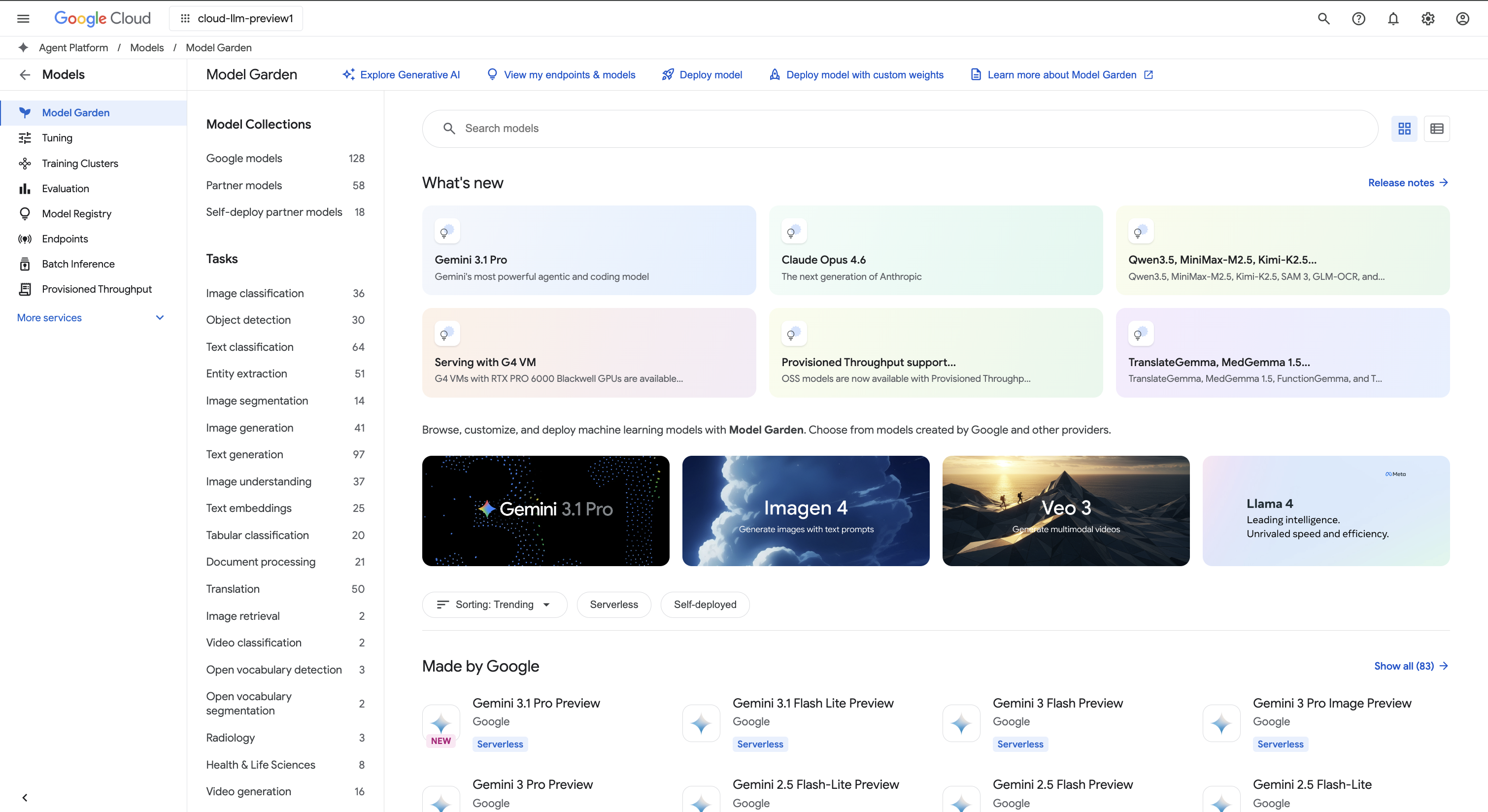
Models and tools supply the application’s capabilities. Model Garden offers Google, partner and open models. Agent Registry provides a catalogue of agents and MCP servers, including remote agents that can participate through Agent2Agent connections. Current Agent Studio connections use registered MCP servers; direct MCP and legacy search-store integrations are deprecated. IAM and configured authentication determine which tools and business resources an agent can access.
Conversation state and long-term memory serve different purposes. Sessions keep the history and state of one conversation. Memory Bank extracts, stores and retrieves information across sessions for continuity and personalization. Neither is simply the working RAM allocated to a running container. Their retained data, read/write operations and any model work involved in memory generation contribute separately to usage costs.
Agent Identity provides a granular identity for an agent, with IAM permissions for resources such as storage or data sets. Agent Gateway can enforce configured access policies on calls to tools and other agents. Human approval is a separate application feature: ADK’s experimental tool confirmation can pause a configured tool for yes/no or structured input. Its current session-service exclusions mean that approval support needs to match the application’s actual state-management design.
The platform provides evaluation and operational visibility through Google Cloud services. Runtime monitoring includes request counts, latency and allocated CPU and memory time. Additional ADK telemetry, traces and logs support inspection of execution, while evaluation services help assess behavior against configured criteria. Deferred scheduling is a separate preview for supported Deep Research workloads; it queues work for later capacity rather than supplying a recurring calendar schedule for every agent.
The Managed Agents API is another build path, distinct from deploying your own application on Agent Runtime. It uses configuration-driven agents in a managed sandbox, with an Agents API for configuration and an Interactions API for runtime requests. Its current preview permits limited testing and evaluation only, excludes commercial or production use, and prohibits proprietary, sensitive or confidential inputs. Model usage remains chargeable. This restriction applies to that API, rather than every production service in the wider platform.
Best for
- Google Cloud teams building and operating agent applications
- Developers combining models, enterprise data and custom tools
- Organizations needing managed runtime, agent identities and observability
Limitations
This is a developer cloud platform that requires project, billing and permission setup. Resource free allocations are account-wide and do not cover every service. Agent Studio currently stores agent configurations in us-west1. ADK tool confirmation is experimental and does not support DatabaseSessionService or VertexAiSessionService. The separate Managed Agents API is restricted to limited testing and evaluation, excludes commercial or production use, and must not receive proprietary, sensitive or confidential data; its model calls are still billed. Ordinary Agent Runtime deployments have a different scope.
Gemini Enterprise Agent Platform features
Visual Agent Studio
Design agents through prompts and a flow builder, preview responses, connect subagents and work with generated Python code.
Open-source Agent Development Kit
Build custom tools, defined workflows and adaptive multi-agent applications, with local and cloud deployment options.
Managed Agent Runtime
Host compatible agent applications through source-code or container deployment paths with managed scaling.
Model Garden and registered tools
Use Google, partner or open models and connect registered MCP tools or remote Agent2Agent agents.
Sessions and long-term memory
Keep conversation state in Sessions and cross-session information in Memory Bank, separately from runtime RAM.
Agent identity and gateway policies
Assign resource permissions to agent identities and enforce configured tool-access policies through Agent Gateway.
Configured ADK tool confirmation
Pause selected tools for human or supervisory input, with experimental status and session-service limitations.
Evaluation and cloud observability
Inspect requests, latency and resource usage, add telemetry, and use evaluation services for application-specific criteria.
Gemini Enterprise Agent Platform pricing
The platform uses metered cloud resources rather than a single per-seat subscription. Base Agent Compute is $0.085 per vCPU-hour, working RAM is $0.009 per GiB-hour and storage is $0.30 per GiB-month. Monthly account-wide free allocations cover 50 vCPU-hours, 100 GiB-RAM-hours and 1 GiB-month of storage. Model inference, embeddings, gateway traffic, session and memory operations, and other enabled services can add charges. Runtime compute and RAM are not billed while waiting between conversation turns; stored data and other services have their own meters. Eligible new customers can receive up to $300 in shared Google Cloud trial credits.
Example plans and usage rates; additional charges may apply.
Agent Compute — base rate
USD 0.085 / vCPU-hour
Current documented product
Plan details
Per active vCPU-hour after 50 free vCPU-hours/month/account. RAM, storage, inference and other services are separate; commitment savings require their own terms.
Agent RAM — base rate
USD 0.009 / GiB-RAM-hour
Current documented product
Plan details
Per GiB-RAM-hour after 100 free GiB-RAM-hours/month/account. Active resource usage is metered; model and other service charges are separate.
Agent Storage — base rate
USD 0.3 / GiB-month
Current documented product
Plan details
Per GiB-month after 1 free GiB-month/month/account. Storage is prorated hourly; model, embedding and other service usage is separate.
Technical specifications
Automation and agents
| Feature | Gemini Enterprise Agent Platform |
|---|---|
| Connectors and tool access | ADK or Agent Studio connect models, tools and agents. Studio uses registered MCP servers and A2A subagents; legacy direct MCP/search integrations are deprecated.Configured Agent Registry, agent identity and IAM permissions |
| Triggers and scheduling | Application/runtime APIs invoke agents. Deferred scheduling is a preview for supported Deep Research workloads, not universal recurring schedules.Application invocation; workload-specific scheduling preview |
| Human approval controls | Experimental ADK confirmation supports yes/no and structured responses for configured tools. DatabaseSessionService and VertexAiSessionService are not supported.Configured tool and supported session implementation |
| Hosting and deployment | Managed Agent Runtime accepts compatible source/container applications; ADK can also run locally or on Cloud Run/GKE. Managed Agents API has separate testing-only restrictions.Chosen deployment service, runtime contract and application operations |
| Execution accounting | Compute, working RAM and storage have account-wide free allocations. Models, gateway, retained state, operations and other services add charges; Runtime waiting between turns is not billed for active resources.Resource-specific base rates and separate services |
| API access | SupportedDeveloper SDK/API and runtime requests; Managed Agents API is a distinct restricted preview |
Gemini Enterprise Agent Platform alternatives
Explore other platforms for business agents, visual AI applications and custom flows.
Microsoft Copilot Studio
Business agents and connected processes within managed Power Platform environments.
Gemini Enterprise Agent Platform FAQs
Is Gemini Enterprise Agent Platform the same as the Gemini Enterprise app?
No. Agent Platform is the Google Cloud development and operations stack for building applications. The Gemini Enterprise app is an employee-facing experience that can use connected agents. Its app licenses do not imply that every platform resource or model call is included.
How much does Gemini Enterprise Agent Platform cost?
Base resource rates are $0.085 per vCPU-hour for compute, $0.009 per GiB-hour for working RAM and $0.30 per GiB-month for storage. Model inference, embeddings and other enabled services add their own charges. There is no single resource price that represents a complete task or the total application bill.
Is Gemini Enterprise Agent Platform free?
Monthly account-wide free resource allocations include 50 vCPU-hours, 100 GiB-RAM-hours and 1 GiB-month of storage. Eligible new customers can also receive shared Google Cloud trial credits. Additional agents do not each receive a fresh account-wide allowance, and model or other service usage can still be charged.
Can I build agents visually without writing everything in code?
Yes. Agent Studio supports prompt-based creation, a visual flow builder, interactive previews and generated Python code. Knowledge is added through the builder rather than prompt-based creation. The current designer stores configurations in us-west1 and uses registered MCP tools and subagents.
Can ADK applications run outside managed Agent Runtime?
Yes. ADK is an open-source framework and can run locally or on services such as Cloud Run or Google Kubernetes Engine. Those deployments need their own infrastructure and operations. Agent Runtime is the separate managed service for compatible applications.
Does ADK support human approval?
ADK’s experimental tool confirmation supports yes/no decisions and structured input for configured tools. It currently excludes DatabaseSessionService and VertexAiSessionService. IAM resource permissions and a human confirmation step are separate controls.
Can the Managed Agents API be used in production?
Its current preview is limited to testing and evaluation, excludes commercial or production purposes, and must not receive proprietary, sensitive or confidential data. Model calls are billed at standard rates. These restrictions belong to the Managed Agents API and should not be applied to all ordinary Agent Runtime deployments.
What are the best Gemini Enterprise Agent Platform alternatives?
Microsoft Copilot Studio combines business agents with Microsoft 365 and Power Platform. Dify provides visual AI applications and knowledge workflows with Cloud or Community deployment. Langflow focuses on visual agent flows and Python components. These offer different balances of application building, cloud operations and visual control.
Is this your product? Claim this page to update your listing.