

ResearchRabbit
Explore papers through citation maps
Start with a relevant paper, follow its references and citations, and build a map of related research. ResearchRabbit helps you explore a field before you write about it.
Free plan availableAccount required
- Access
- Free and paid plans
- Example plan
- USD 12.5 / monthRR+ — monthly
- Available on
- Web
What is ResearchRabbit?
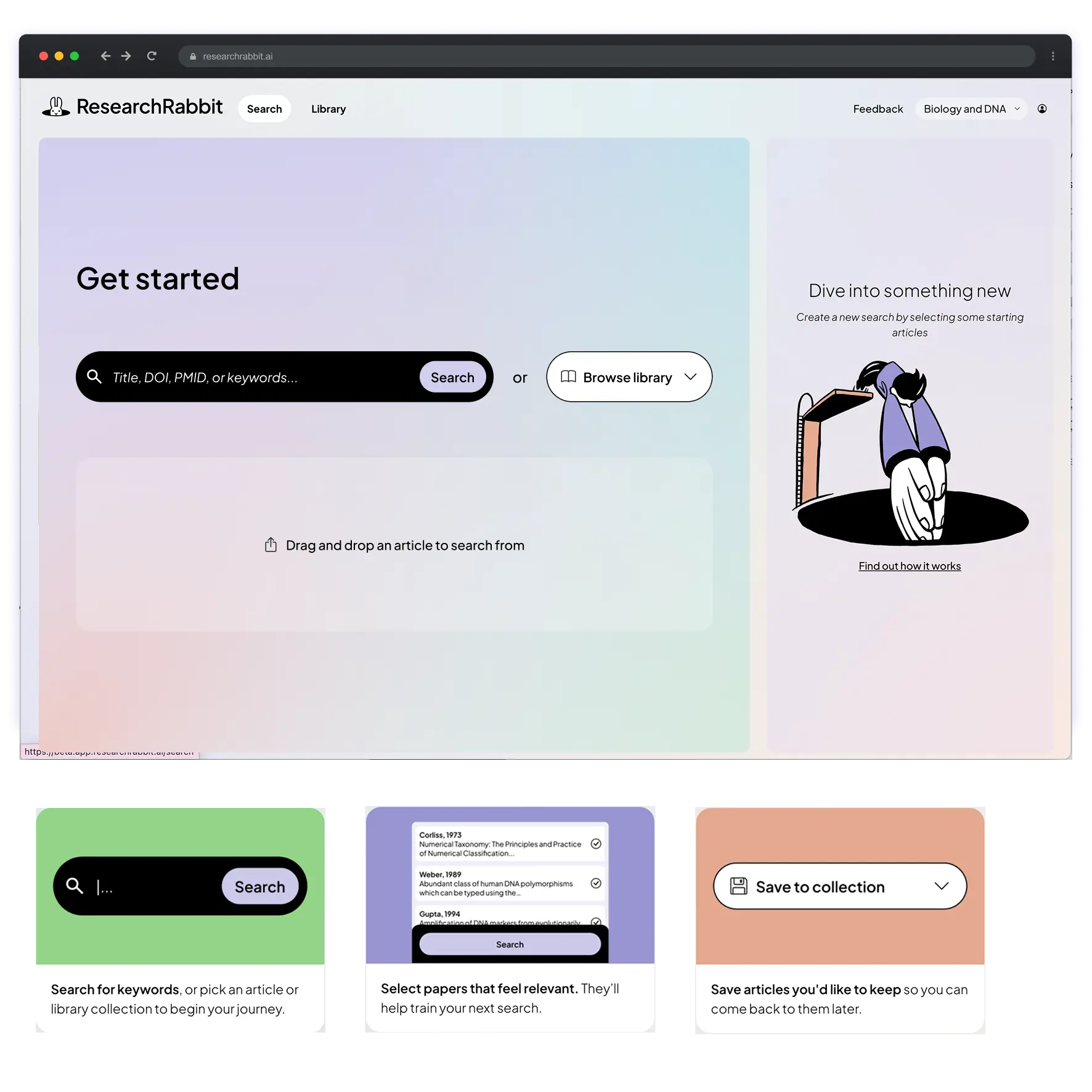
ResearchRabbit helps build a reading list by following relationships between papers. Start with a relevant article, then explore references, later citations and similar work through a visual map.
Collections, subcollections, notes and sharing organise what you find. The free tier includes citation maps, a Zotero importer and BibTeX import/export; RR+ adds larger seed sets, filters and multiple projects.
Grow the search from relevant papers
Begin with a few useful seed papers, follow references backward and citations forward, then read promising results and refine the collection. Free searches can use up to fifty starting articles; RR+ raises this to three hundred and adds keyword, date, journal, open-access and retraction filters. A larger map does not establish complete coverage or agreement between studies.
Move and share collections deliberately
Zotero support is an import workflow rather than automatic two-way synchronization. Authorize a collection and select the articles to import; use BibTeX export to move discoveries back to a reference manager.
A public collection link allows viewing without an account. Collaboration invitations allow editing. Choose the sharing method according to who should see or change the reading list.
Use the map to guide reading
Citation links do not establish that a paper supports a claim or has sound methods. A formal evidence review still needs a documented database search and direct reading of included studies. The map helps find the next paper to inspect.
Best for
- Expanding a reading list from seed papers
- Exploring a field through citation relationships
- Shared paper collections alongside a reference manager
Limitations
Citation relationships and recommendations do not validate a study or prove complete literature coverage. Free searches start from up to 50 articles; RR+ allows up to 300. Paper discovery is separate from full-text access.
ResearchRabbit features
Citation-network discovery
Explore references, citing work and related articles from seed papers.
Collections and reading notes
Organise discoveries into collections and subcollections with notes and sharing.
Reference-library handoff
The free tier includes Zotero importing and BibTeX import/export.
RR+ search controls
Premium adds larger starting sets, advanced filters and multiple research projects.
One-way Zotero import
Choose records from an authorized Zotero collection, then export discoveries as BibTeX for the return trip. The documented importer is not continuous two-way sync.
View links and editing invitations
Share a collection publicly for viewing or invite collaborators to work on it. Public visibility and editing permission are different choices.
ResearchRabbit pricing
The core tier is free. RR+ is advertised at USD 12.50 monthly or USD 120 paid annually. It adds advanced search filters, up to 300 seed articles and multiple projects. Country-parity discounts may apply in the app; they are not universal prices.
Example plans.
RR+ — monthly
USD 12.5 / month
ResearchRabbit+
Plan details
Standard advertised monthly price; eligible countries may receive discounts in the app.
Technical specifications
Search and research
| Feature | ResearchRabbit |
|---|---|
| Source corpus | Academic papers connected through references, citations and related-work discovery.Literature-discovery workspace |
| Citation workflow | Citation maps support exploring earlier/later/related work; they do not establish study validity.Discovery rather than evidence verification |
| Research workflow | Free searches from up to 50 seed papers; RR+ allows up to 300 with advanced filters and multiple projects.Free versus RR+ |
| Export formats | Free includes BibTeX import/export and a Zotero importer.Free tier |
ResearchRabbit alternatives
Choose the workflow that matches the material you want to create or capture.
Semantic Scholar
Semantic Scholar suits broad scholarly searches and individual paper records. ResearchRabbit follows connections from papers you already consider relevant.
Elicit
Elicit suits structured study screening and evidence extraction against a research question; citation mapping can complement that work.
Consensus
Consensus starts with a research question and research-backed answers. Read the underlying studies before citing a conclusion.
ResearchRabbit FAQs
Is ResearchRabbit free?
Its core tier is free and includes citation maps, collections, Zotero importing and BibTeX import/export. RR+ adds advanced filters and larger seed sets.
How much does ResearchRabbit+ cost?
RR+ is advertised at USD 12.50 monthly or USD 120 annually. Country-based discounts can be shown inside the application.
Does a citation map replace a systematic review?
No. It helps discover related work. Formal reviews still need appropriate database searches, inclusion criteria and direct assessment of the studies.
Can I bring in my reference library?
The free tier documents a Zotero importer and BibTeX importing and exporting. These help move paper records between ResearchRabbit and a reference workflow.
Does the Zotero connection synchronize both libraries automatically?
The current guide describes importing selected Zotero records into ResearchRabbit. The return route is a BibTeX export that Zotero can import. It labels two-way synchronization as future work, so do not rely on edits propagating automatically.
Can someone view my shared collection without signing up?
A public collection link allows viewing without an account. Inviting a collaborator gives editing access; adding the collection to a separate ResearchRabbit project and running searches requires an account. Check whether public viewing is appropriate for the collection.
Does an open-access filter prove a study is reliable?
No. Open access describes access to the text, not methodological quality. Journal measures and retraction/risk signals can guide what to inspect; they do not replace reading the study or checking whether it supports your claim.
Should I start with fifty seed papers?
Not necessarily. A few relevant seeds can establish a useful direction. Add or remove papers as you read the results, rather than treating the plan’s maximum seed count as a recommended starting size or a completeness guarantee.
Explore related AI tools
Is this your product? Claim this page to update your listing.