

Consensus
Consensus AI review: cited answers from scientific research
Consensus searches scientific papers and builds cited research answers. Explore Pro and Deep reviews, full-text access, pricing, exports and alternatives.
Free plan availableAccount required
- Access
- Free and paid plans
- Example plan
- USD 20 / monthPro
- Available on
- Web, API
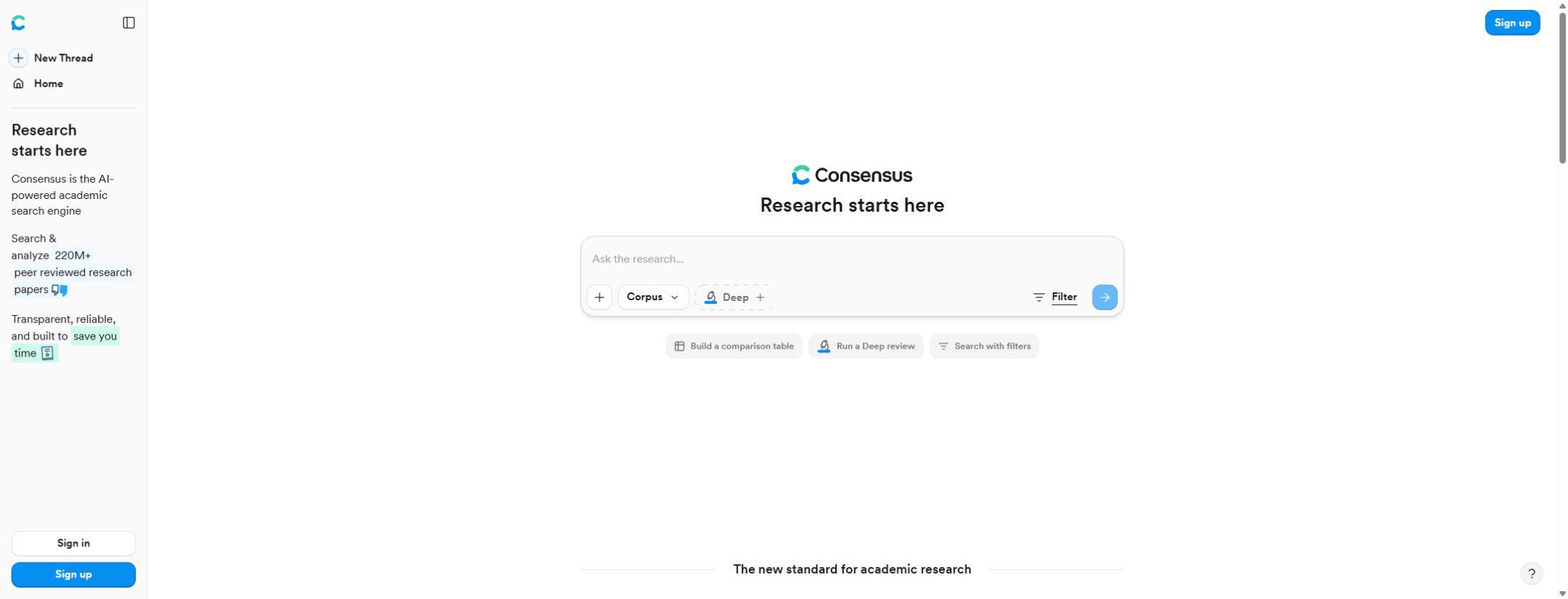
Scientific search with cited answers and deeper literature reviews
Consensus is an academic search engine for questions that need published research behind them. It retrieves scientific papers and can turn selected results into a cited answer. The index brings together scholarly metadata, open-access text and licensed publisher content. It also includes labelled preprints, so a search result should not automatically be treated as peer-reviewed evidence.
Paper search returns a ranked list without an AI summary. Pro messages provide a shorter synthesis, while Deep reviews run several related searches and analyse a larger selection of studies. The Research Agent supports follow-up questions, citation crawling, author and DOI searches, exclusions and comparison tables. These modes make research easier to explore; they do not establish that every relevant paper was found.
Citations expose supporting quotations. A checkmark means the paper’s full text was used for that analysis; without one, Consensus used the abstract and available metadata. Full text comes from open-access papers, publisher agreements and uploaded material. Permission to analyse a paywalled paper does not necessarily include permission for you to read or download the article. Institutional LibKey connections provide library links rather than additional text for the AI.
Consensus can present more than a prose answer. The Consensus Meter summarises the stances of selected papers for yes-or-no questions. Claims-and-evidence tables, timelines, research-gap matrices and figures from cited open-access papers can make results easier to examine. The available outputs depend on the question and evidence. The Meter represents a subset of retrieved studies and can misclassify a result; it is not a measure of the entire scientific literature.
My Library stores saved papers, Collections and uploaded documents for later questions. A question can use selected papers, a specific Collection or the wider Library in Pro or Deep mode. Zotero import preserves collections and can bring in stored PDF attachments. It is a one-way import that needs to be repeated for new items. Some Zotero item types can be stored but are not yet included in search or analysis; externally linked PDFs do not import.
Search results and saved paper lists export as CSV or RIS for reference managers. Deep reports can be copied with citations or exported as PDF, with bibliography and citation-style options available. These are different outputs: a list of references is not the same as an exported research report. Zotero’s browser connector also supports saving papers from results or individual paper pages.
Free access includes unlimited basic paper searches and limited advanced analysis. Paid Pro and Deep subscriptions expand the allowances, with the Deep plan offering more Deep reviews. The Pro search mode and Pro subscription are different things: free users can run a limited number of Pro messages. A free Deep review also consumes a Pro-message credit. Team plans add individual accounts and central billing; annual individual pricing requires the full yearly payment.
Consensus also supplies scientific search through an API and MCP integrations. Those services share their own monthly call pool, separate from the allowance for Deep reviews. Paid users can opt into additional billed calls up to a plan maximum; extra usage is disabled by default. One call covers up to 100 papers, and larger result sets consume more calls. This makes the integration useful for research applications while keeping its costs distinct from an ordinary web-app search.
Best for
- Researchers and students looking for cited scientific answers
- Analysts comparing published studies and mapping evidence gaps
- Teams bringing academic search into research applications
Limitations
AI analysis and the Consensus Meter can miss context or classify a study incorrectly. Full-text analysis does not grant access to every article, and some imported Zotero item types are stored without being searchable. Advanced research and API usage have separate allowances.
Consensus features
Scientific search and filters
Search scholarly records and narrow results by publication date, study type, population, sample size and other research criteria. Labelled preprints can be excluded; basic paper search returns a ranked list without synthesis.
Pro messages and Deep reviews
Pro analyses a smaller selection of papers; Deep expands the search and synthesis. Research Agent tools support related-paper discovery, citation tracing and follow-up questions. A deeper response is not proof of exhaustive coverage.
Citations with full-text indicators
Supporting quotations connect an answer to its sources. A citation checkmark indicates full-text analysis; an unmarked citation relies on the abstract and metadata. Reading a licensed article can still require your own access.
Consensus Meter
Visualise the positions of selected studies on a yes-or-no question. The display needs enough relevant papers and can misclassify findings or miss a population-specific distinction.
Evidence tables and research visuals
Analysis can include claims-and-evidence tables, publication timelines, gap matrices and figures from cited open-access papers. Not every search produces each output.
Library, Collections and uploads
Question saved papers, selected Collections or uploaded research documents in Pro or Deep mode. Uploaded material is private unless you choose to share a Collection containing it.
Zotero import
Bring Personal or Group Libraries and collection structure into Consensus. Stored, file-synced PDFs can import; external PDF links cannot. Imports are one-way, and some stored item types are not yet searched or analysed.
Reference and report exports
Paper lists export as CSV or RIS, while Deep analysis can be copied with citations or saved as PDF. Citation formats and reference-manager exports serve different parts of academic writing.
API and MCP search
Use scientific retrieval inside custom applications or compatible AI clients. API and MCP share calls that reset on the first of the month; optional paid overages have plan maximums. Eligible full-text excerpts require a paid plan.
Consensus pricing
Free includes basic paper search and limited advanced analysis. Pro adds unlimited Pro messages and a higher Deep-review allowance; Deep expands that allowance further. Team and Enterprise pricing depends on the organisation. Individual subscriptions offer monthly or full annual billing. API and MCP use a separate shared call pool, with opt-in paid overages and plan maximums. Published plan prices and overage terms checked on 9 October 2026.
Example plans.
Pro
USD 20 / month
Consensus
Plan details
Unlimited Pro messages; 15 Deep reviews and 500 API/MCP uses monthly.
Deep
USD 65 / month
Consensus
Plan details
200 Deep reviews and 2,000 API/MCP uses monthly.
Technical specifications
Search and research
| Feature | Consensus |
|---|---|
| Source corpus | Scientific paper metadata, available open-access full text and licensed publisher text. Labelled preprints are also included; reading rights differ from analysis access.Paper availability and selected corpus vary |
| Citation workflow | In-line citations reveal supporting quotes. A checkmark indicates full-text analysis; without one, the abstract and available metadata were used.Source traceability is not a guarantee of correct interpretation |
| Document inputs | Use uploaded documents, saved papers, a Collection or the full Library for questions in Pro or Deep mode. Zotero imports are one-way and some stored item types are not searchable.Mode allowance and source access apply |
| Research workflow | Research Agent supports citation tracing, DOI/author searches and comparisons. Pro provides shorter synthesis; Deep broadens research. Tables and visual outputs depend on the question and papers.No claim of exhaustive systematic review or fixed output count |
| Export formats | Paper results and saved lists export CSV/RIS. Deep reports can copy citations or export PDF; bibliography styles are output-specific.Reference lists versus research reports |
| Research allowance (queries per stated period) | 3Free: up to 3 Deep reviews monthly; each also uses a Pro-message credit from the 10 included monthly Pro messages. |
| API access | SupportedAPI and MCP share monthly calls, separate from Deep-review allowance; paid opt-in additional calls and plan maximums apply |
Consensus alternatives
Elicit adds dedicated review screening and extraction, Scite examines citation context, and Semantic Scholar provides academic discovery and citation connections.
Elicit
Dedicated systematic-review screening and structured evidence extraction on eligible plans.
Semantic Scholar
Free scholarly discovery with paper, author and citation connections.
Consensus FAQs
What is Consensus AI used for?
Consensus finds scientific papers and generates cited research answers. Its Research Agent supports related-paper discovery and study comparisons, while Deep produces broader literature-style analysis. Saved Collections and uploaded documents can also supply material for questions.
Is Consensus free?
Yes. Basic paper search is unlimited, while free Pro messages, Deep reviews and Study Snapshots have monthly allowances. The Pro search mode is available with free credits and is distinct from the paid Pro subscription. A free Deep review also uses a Pro-message credit.
What is the difference between Pro and Deep?
Pro messages provide shorter analysis; Deep runs a wider research task. Separately, the Pro subscription includes 15 Deep reviews per month, while the Deep subscription includes 200. Free accounts have up to three. Those are review allowances, not promises about coverage or the number of papers cited.
Does Consensus give me access to paywalled papers?
It can use licensed publisher full text for analysis, but the article itself may remain paywalled. Open-access papers and uploads provide other full-text sources. Institutional LibKey links help you reach articles through your library; they do not add that subscription’s text to the AI analysis.
Does the Consensus Meter show a scientific consensus?
It summarises the positions of a selected set of relevant retrieved papers. It does not represent every study on the topic and can misclassify findings or miss important context. The contributing papers remain necessary for understanding what the display means.
Does Consensus sync automatically with Zotero?
No. Zotero import is one-way and needs to be repeated to add new material. Stored PDFs available for file syncing can import, but PDFs linked from external storage cannot. Some imported item types are stored without yet participating in search or analysis.
Can I export Consensus research and citations?
Search results and saved paper lists export as CSV or RIS. Deep reports can be copied with citations or exported as PDF, with citation-style options. Zotero’s browser connector also saves papers from Consensus results and details pages.
What are the main Consensus alternatives?
Elicit offers structured screening and extraction for systematic reviews. Scite examines how later papers refer to a study. Semantic Scholar is a free option for scholarly discovery and citation connections. Their different research functions make the alternatives useful for different kinds of questions.
Is this your product? Claim this page to update your listing.