

Replit
Replit review: AI app building with code and cloud hosting
Replit builds web and mobile apps with AI, an editable codebase and cloud hosting. Explore its plans, usage credits, SEO features and deployment options.
Free plan availableAccount required
- Access
- Free and paid plans
- Example plan
- USD 20 / monthCore — monthly
- Available on
- Web, Desktop, Mobile
Build the app, edit its code and run it in one workspace
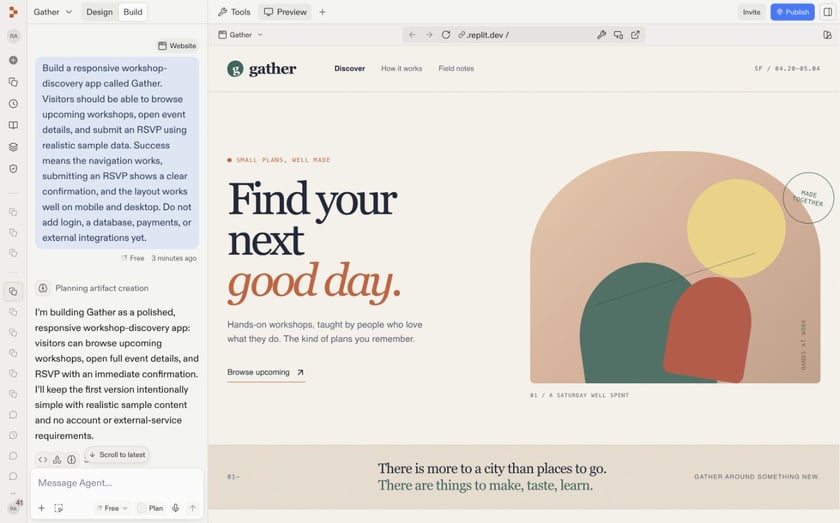
Replit brings an AI app builder, a code editor and cloud hosting into the same workspace. Agent can create websites, customer dashboards, internal tools and full-stack web apps from a description. The files remain editable, with a terminal and Git tools alongside the preview. It suits teams that want to start with prompts and continue developing the resulting code, rather than handing a prototype to a separate development environment.
Its mobile app path goes beyond a responsive website. Agent can build native iOS and Android apps, with device previews and Expo Go for trying the project on a phone. The Launch feature builds and uploads an iOS app to App Store Connect through Expo. Apple Developer membership and a separate store review are still required; uploading a build does not make the app publicly available. Web and mobile artifacts can share a project’s backend and database.
Free Mode provides an included AI allowance that varies by plan. Power and Max handle paid Agent work, charging according to the effort a request requires. Plan Mode can reason through changes before implementation, but that reasoning may also use credits. Starter offers limited daily Agent usage and one free published app that expires after 30 days. Core adds full Agent builds and collaboration for up to five builders; Pro raises the builder limit to 15 and supports ten concurrent background tasks instead of Core’s one.
Development and production are separate. Changes stay in the editor and preview until the next publish. Replit provides managed PostgreSQL for structured records and App Storage for files such as images and documents. Development databases are free; production resources follow usage allowances and billing rates. Code checkpoints and production database recovery are separate controls. Core offers up to seven days of production history, while Pro can extend retention to 28 days; longer retention affects stored backup volume.
For public websites, publishing includes an SEO rating based on a technical audit. Paid builders also get SEO Agent in the Growth pane, with findings covering crawlability, rendering, metadata and other technical issues. Agent can add page titles, descriptions, image alt text, social previews, robots.txt and a sitemap. Ratings apply to public web-facing deployments, rather than scheduled jobs or private apps. These features help prepare a site for search; they do not establish that its pages are indexed or ranking.
The subscription is only part of the running cost. Monthly usage credits cover eligible Agent work and cloud resources, so app traffic can draw from the same balance as development. Autoscale meters compute, requests and outbound data; Reserved VM keeps a machine running, Static serves files, and Scheduled runs timed jobs. Pro pools credits across the workspace and rolls unused subscription credits over for two months. Spending controls can limit extra usage or suspend services at a shutdown threshold. Git keeps source portable, but moving a live app also requires its data, files, secrets and hosting configuration.
Best for
- Founders building web apps, mobile prototypes and internal tools
- Developers who want editable code alongside AI generation
- Small teams combining development, databases and deployment
Limitations
Starter’s free published app expires after 30 days and carries Replit branding. Full Agent builds and advanced integrations require a paid plan. Power and Max use variable effort-based billing; Plan Mode can use credits without changing code. App traffic and production resources also consume eligible credits. Service shutdown limits can take a live app offline. Mobile store publication needs the relevant developer account and review, and Git source alone does not move live data or secrets.
Replit features for building and running apps
Web apps with an editable codebase
Create a frontend, API routes and backend logic from a prompt. The code editor, terminal and preview remain available for direct development alongside Agent.
Native mobile apps and Expo previews
Build iOS and Android apps and try them through a device preview or Expo Go. Launch uploads iOS builds to App Store Connect; Apple’s developer account and review remain separate.
Free Mode, Power and Max
Use the plan’s included Free Mode allowance or paid effort-based Agent modes. Plan Mode supports discussion before code changes, and can itself consume paid usage credits.
Managed data and file storage
PostgreSQL stores structured app records, while App Storage handles images, documents and other files. Development and production databases have separate usage and recovery controls.
Four deployment options
Autoscale responds to traffic, Reserved VM keeps a service running, Static serves files and Scheduled runs timed jobs. Published releases stay separate from ongoing edits.
SEO rating and SEO Agent
Public web deployments receive a technical SEO rating. Paid builders can use SEO Agent to identify issues and prepare fixes for metadata, crawlability and rendering.
Small-team collaboration and pooled credits
Core supports five builders and one active background task. Pro supports 15 builders, ten tasks in parallel, pooled credits and two-month subscription-credit rollover.
Git and separate recovery controls
Manage commits, branches and connected repositories in the Git pane or terminal. Code checkpoints and production database restores are separate; live files, data and secrets need their own migration.
Replit pricing
Starter is free with limited Agent and cloud allowances and one published app that expires after 30 days. Core adds full Agent builds and small-team collaboration. Pro adds a larger pooled allowance, more parallel tasks, credit rollover and longer database recovery. Enterprise uses custom terms. Power and Max requests have variable costs, and production resource usage can exceed the included credits. Annual and monthly billing differ; taxes may apply.
Example plans.
Core — monthly
USD 20 / month
Replit
Plan details
USD 20 monthly usage credits. Agent and cloud usage beyond the allowance adds cost; applicable taxes are extra.
Core — annual commitment
USD 18 / month
Replit
Plan details
Displayed monthly equivalent billed annually. USD 20 monthly usage credits.
Pro — monthly
USD 100 / month
Replit
Plan details
Starting tier with USD 100 monthly credits, up to 15 collaborators and 50 viewers. Higher credit tiers cost more.
Technical specifications
App and website builders
| Feature | Replit |
|---|---|
| Application outputs | Full-stack web apps, websites, dashboards and native iOS/Android apps. Artifacts in a project can share backend services. Mobile previews use Expo Go; iOS uploads and store approval are separate.Web and mobile app output |
| Code ownership and export | Editable source, commits, branches and connected Git repositories in the Git pane or Shell. Moving a live app also requires database records, uploaded files, secrets and hosting configuration.Source repository versus running app |
| Database and backend | Managed PostgreSQL for structured data and App Storage for files. Development databases are free; production resources follow usage allowances and billing rates. Production recovery is separate from code checkpoints.Development and production resources |
| Hosting and deployment | Autoscale, Reserved VM, Static and Scheduled deployments. Starter allows one free published app that expires after 30 days. Live releases are separate from editor changes; public web deployments support SEO ratings.Deployment and publishing access |
| Generation and hosting limits | Free Mode has plan-dependent included allowances. Power and Max use effort-based billing; Plan Mode may use credits without edits. Eligible Agent and cloud usage share plan credits. Core supports five builders/one task; Pro supports 15/ten tasks and two-month rollover.Included allowance and metered usage |
Replit alternatives
Bolt, Lovable and v0 offer other ways to build apps with AI, editable source and managed deployment. Their reviews cover each platform’s editor, backend and billing.
Replit FAQs
What is Replit used for?
Replit combines AI app creation with a hosted code editor, databases and deployment. It can build websites, full-stack web apps, internal tools and native mobile apps, while leaving the source available for direct development.
Is Replit free?
Yes. Starter includes limited Agent and cloud allowances and one free published app. That app carries Replit branding and expires after 30 days, with republishing available. Full Agent builds and advanced integrations require a paid plan.
What is the difference between Replit Core and Pro?
Core supports up to five builders and one active background task. Pro supports 15 builders, ten concurrent tasks and pooled subscription credits that roll over for two months. Production database recovery extends from Core’s seven-day maximum to up to 28 days on Pro.
Are Replit credits a fixed number of prompts?
No. Power and Max requests are charged according to effort, and Plan Mode reasoning can use credits without changing code. Eligible app hosting, database and storage usage also draw on the balance. Free Mode has its own plan-dependent allowance.
Does Replit include unlimited hosting?
Replit includes hosting options and plan allowances, but production resources are metered. Costs depend on deployment type, compute, requests, outbound data and other resources. Included credits can cover eligible usage; additional usage can add charges, and a service shutdown limit can suspend the app.
Can Replit build native mobile apps?
Yes. Replit supports native iOS and Android projects with device previews and Expo Go testing. Its Launch flow builds and uploads an iOS app through Expo to App Store Connect. Apple Developer membership and store review are separate from building and uploading the app.
Can Replit websites appear in Google search?
Public websites can be prepared for search with page metadata, a sitemap, robots.txt and structured data. Public web deployments receive a technical SEO rating, and paid builders can use SEO Agent for fixes. Private and scheduled deployments do not receive that rating. SEO tooling does not guarantee indexing or rankings.
Can I move a Replit app to another host?
The source is editable and can be pushed to a Git repository. A complete move also needs the production database, uploaded files, environment secrets, provider connections and deployment setup. Restoring code alone likewise does not restore a production database.
Is this your product? Claim this page to update your listing.