

Lovable
Lovable review: AI web apps with editable code
Lovable builds AI web apps with editable code, a hosted backend and Git sync. Explore its pricing, shared credits, SEO features and deployment options.
Free plan availableAccount required
- Access
- Free and paid plans
- Example plan
- EUR 25 / monthPro — monthly
- Available on
- Web
From an app idea to a hosted product, with a codebase to keep
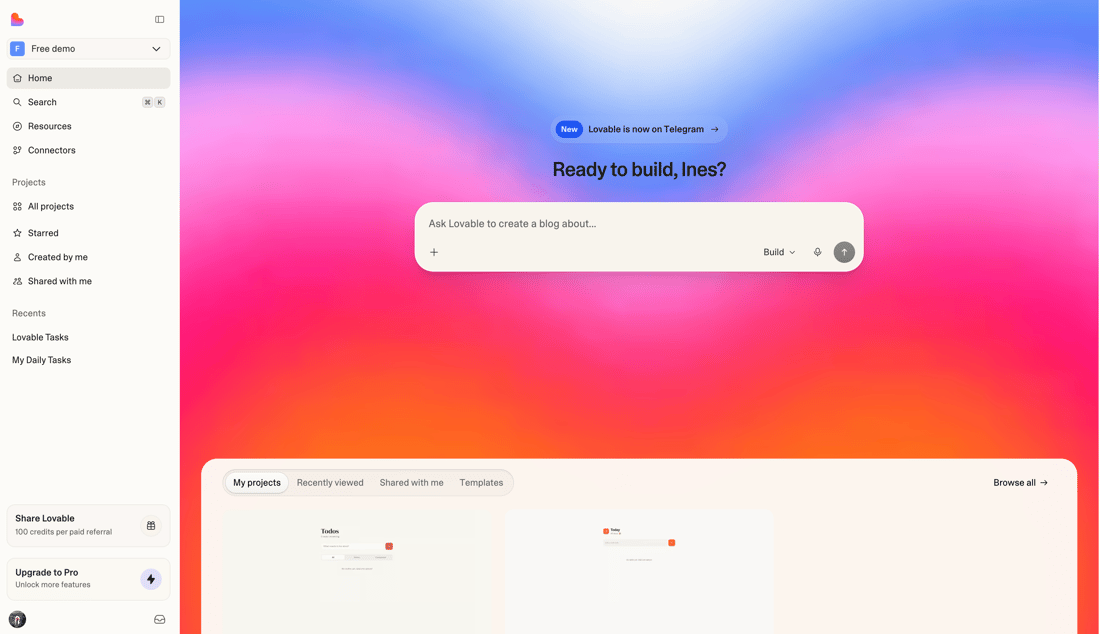
Lovable is a compelling option for founders and teams building customer portals, internal dashboards and web apps without starting from a blank codebase. A prompt generates the interface and application logic, with a live preview beside the conversation. Lovable Cloud supplies data storage, user accounts and backend functions, and publishing puts the app on a hosted URL. The generated code remains accessible, so a developer can extend the project alongside the AI builder.
The project chat has three distinct modes. Chat discusses the existing app without changing its code. Plan investigates a change and produces an editable plan before implementation. Build changes the app and can run browser checks, frontend tests and backend verification. The preview toolbar adds element selection, inline text editing, drawings and pinned comments. Paid plans also allow direct code editing; manually saving code does not consume AI credits.
Lovable charges by workspace credits rather than seats. Building, chat, backend activity, deployed-app AI and some managed connectors all draw on the same balance, with included grants used first. Build costs vary with the work performed, so 100 credits do not mean 100 prompts. Pro and Business start with the same monthly credit allowance, while Business adds access and governance controls. A larger team shares the existing allowance rather than receiving a separate balance per person.
For public websites, newer projects use TanStack Start with server-side rendering. Older React and Vite projects receive crawler-specific pre-rendering on Lovable hosting and can be upgraded to the newer stack. The built-in SEO tools review metadata, crawl settings, content structure and social previews, and include keyword research and Google Search Console setup. Page titles and descriptions can be changed through chat. These are useful publishing capabilities; search visibility still depends on the site’s content and configuration.
GitHub, GitLab and Bitbucket support two-way code sync on all plans. Paid plans also offer a ZIP download. Source exports include project configuration and stored database migration files, but a complete move needs the live database records, uploaded files, sign-in settings and secrets handled separately. A TanStack Start app requires hosting that runs its server code; an older Vite app can use static hosting. The frontend can move while continuing to use Lovable Cloud, or the backend can be migrated to a compatible service.
Project privacy and website access are separate settings. Free workspaces can keep projects private in the editor and publish public apps. Paid plans add custom domains and badge removal; Business and Enterprise can restrict the published app to workspace members or selected people and groups. Published pages keep serving when credits run out, but AI features stop and the built-in backend can pause. A site that depends on login or database actions can therefore lose important functionality even while its pages remain available.
Best for
- Founders building customer portals and web app MVPs
- Teams creating internal dashboards with a managed backend
- Developers combining AI app creation with a Git workflow
Limitations
Credits are shared across the workspace and build requests have variable costs. Deployed-app AI, backend activity and some managed connectors also use credits. An empty balance can interrupt AI and backend features while published pages stay available. Direct code editing, ZIP export and custom domains require paid plans; restricted live-app access requires Business or Enterprise. Moving source files alone does not migrate live data or connected services.
Lovable features for building and running web apps
Chat, Plan and Build modes
Discuss the app without edits, review a proposed plan, or let Build implement changes. Build mode can investigate the codebase, make coordinated updates and verify the result.
Lovable Cloud backend
Database, authentication, file storage, realtime updates, edge functions and scheduled jobs sit alongside the app editor. An external Supabase backend is another option.
Editing directly from the preview
Select elements, draw annotations, edit text inline and leave pinned comments. AI changes use build credits; inline text editing has free allowances before usage charges apply.
Developer access and Git sync
Keep a two-way repository connection with GitHub, GitLab or Bitbucket on any plan. Paid plans add manual code editing and full ZIP downloads; manual code saves do not use credits.
SEO tools and server-rendered pages
Newer TanStack Start apps render pages on the server. SEO tools cover metadata, crawler settings, social previews, keyword research and Google Search Console setup. Older apps can upgrade from React and Vite.
Publishing, domains and live-app access
Publish a snapshot to a lovable.app URL, then release later edits when ready. Paid plans add custom domains; Business and Enterprise can limit who visits the published app.
Shared workspaces and spending controls
Unlimited workspace members share one credit allowance. Paid plans offer member, project and workspace usage limits and alerts. Business adds SSO, roles and internal publishing.
Code export and outside hosting
Run the frontend on another compatible host and keep Cloud connected, or migrate the backend separately. Database exports, storage files, secrets and runtime integrations need their own migration steps.
Lovable pricing
Free includes limited daily build credits and usage-specific grants. Pro adds direct code editing, code downloads, custom domains and credit top-ups. Business adds SSO, internal publishing and governance controls, rather than a larger starting credit allowance. Enterprise uses custom terms. Plan credits are shared across the workspace, and extra build or runtime usage can require separately billed top-ups. Prices vary by billing cycle and region.
Example plans.
Pro — monthly
EUR 25 / month
Lovable
Plan details
European web price including VAT. 100 monthly workspace credits; unlimited users. Top-ups and usage beyond included balances add cost.
Pro — annual commitment
EUR 21 / month
Lovable
Plan details
Monthly equivalent billed annually, including VAT. 100 monthly workspace credits; top-ups are separately billed.
Business — monthly
EUR 50 / month
Lovable
Plan details
European web price including VAT. 100 monthly workspace credits, team controls, SSO and internal publishing.
Technical specifications
App and website builders
| Feature | Lovable |
|---|---|
| Application outputs | Websites, dashboards, customer portals and web apps with editable source. Newer projects use server-rendered TanStack Start; older projects use React and Vite.Project stack and web output |
| Code ownership and export | Two-way GitHub, GitLab and Bitbucket sync on all plans; full ZIP download on paid plans. Source includes stored migration files. Live database records, storage files, secrets and provider connections move separately.Git sync, code downloads and migration |
| Database and backend | Lovable Cloud provides database, authentication, storage, realtime, edge functions and jobs. An external Supabase backend can also be connected. Backend activity consumes shared workspace credits after applicable grants.Managed Cloud or connected backend |
| Hosting and deployment | Public lovable.app publishing on all plans; custom domains on paid plans. Newer apps use SSR; older apps use verified-crawler pre-rendering on Lovable hosting. Business and Enterprise add restricted live-app access. Outside hosting must support the project stack.Hosting, publishing access and project stack |
| Generation and hosting limits | Workspace credits cover building, chat, backend usage, deployed-app AI and some managed connectors. Free build grants are five per day capped at 30/month. Pro and Business start at 100 monthly plan credits. Grants and general credits have different expiry rules; build costs vary.Shared workspace balance; grants subject to change |
Lovable alternatives
Bolt, Base44 and v0 offer other approaches to prompt-built apps, backend services and deployment. Their reviews cover the differences in editing and billing.
Lovable FAQs
What is Lovable used for?
Lovable builds websites and web apps such as customer portals, internal dashboards and MVPs from natural-language prompts. Its hosted backend adds user accounts, stored data, files and server functions, with editable source behind the app.
Is Lovable free?
Yes. Free includes five daily build credits, capped at 30 per calendar month, plus usage-specific grants. Projects can be private in the editor, and public publishing and Git sync are available. Direct code editing, full ZIP downloads, custom domains and badge removal need a paid plan.
How does Lovable pricing work for teams?
Plans belong to a workspace and are priced by credits, not seats. All workspace members share its allowance. Pro and Business start at 100 monthly plan credits; Business adds access and governance features. Larger credit tiers and paid top-ups are available.
Do Lovable credits cover hosting and app usage?
One balance covers building, chat, backend usage, deployed-app AI and some managed connectors. Usage-specific grants are used first, then available general credits. Build costs vary; a credit is not a fixed number of prompts. Runtime usage can consume credits that would otherwise be available for new development.
Can Lovable websites appear in Google search?
Public apps support search visibility. Newer TanStack Start projects use server-side rendering; older React and Vite apps get pre-rendered pages for verified crawlers on Lovable hosting. SEO tools cover metadata, crawl settings and search setup. Private apps and branded workspace URLs are not indexable, and these features do not guarantee rankings.
Can I export and host a Lovable app elsewhere?
Yes. GitHub, GitLab and Bitbucket offer two-way sync on all plans, while paid plans include a ZIP download. Newer apps need a host that runs their server code. Live data, storage, secrets and sign-in configuration move separately; Lovable-powered AI and connectors still use its services until replaced.
What happens when Lovable credits run out?
Building pauses, deployed-app AI stops and the built-in backend can pause. Published pages keep serving. Chat can continue while the daily chat allowance remains. Adding credits restores availability, but a paused backend may also need to be woken up in Cloud settings.
Does Lovable build native mobile apps?
Lovable builds web apps. It has no built-in flow that packages and submits a project to the App Store or Google Play. A web app can be made installable as a PWA or wrapped with Capacitor outside Lovable. Lovable’s own iOS and Android apps are for building projects, rather than converting them into native apps for end users.
Is this your product? Claim this page to update your listing.