

Writesonic
Writesonic review: AI articles, SEO and AI-search visibility
Writesonic combines AI article writing, SEO audits and brand visibility in AI answers. Explore current features, plan limits, pricing and alternatives.
Paid plansAccount required
- Access
- Paid access
- Example plan
- USD 99 / monthStarter monthly
- Available on
- Web, API
Create content and follow your brand in AI search
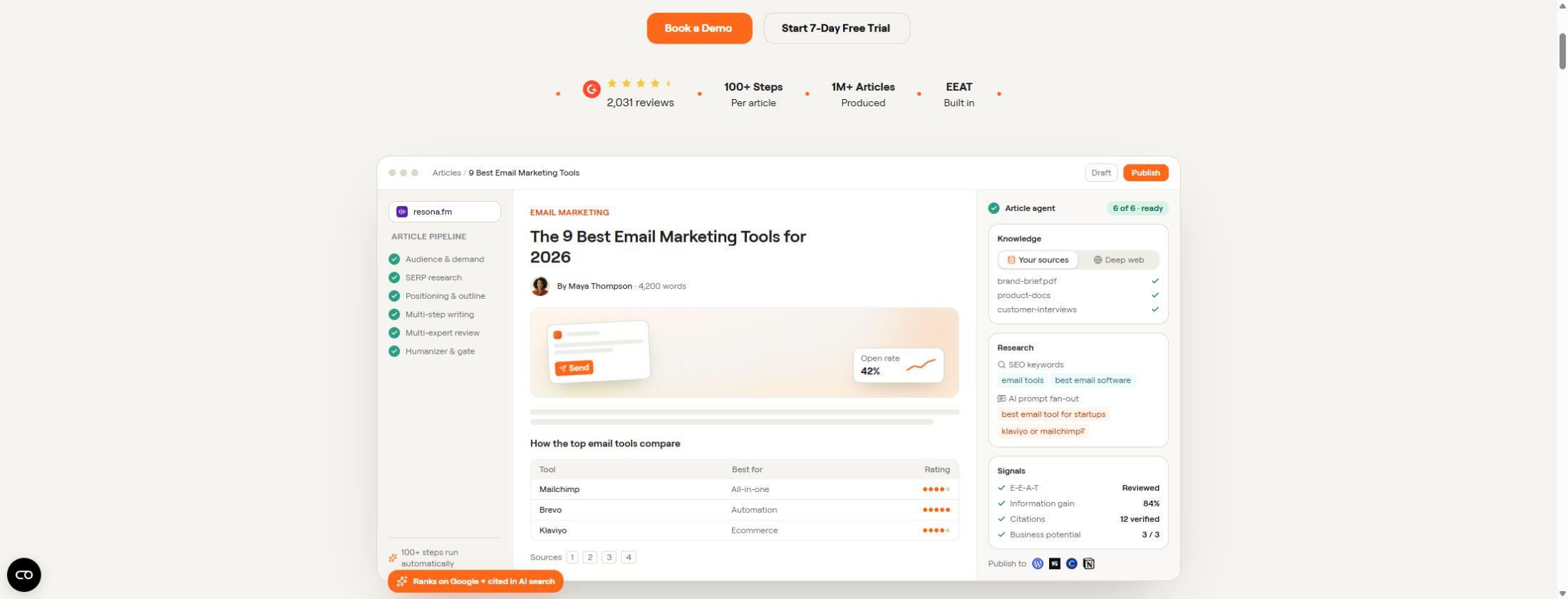
Writesonic combines article creation, SEO tools and AI-search visibility monitoring. It is aimed at marketing teams that publish content and want to understand how AI answers describe their brand. Article Writer develops research, an outline and a long-form draft, while visibility reports follow configured prompts across the engines included in a subscription. The combination is broader than a standalone writing assistant.
Article Writer can start from company knowledge or web research. Uploaded PDFs, DOCX files and source URLs bring product information, brand material and first-hand insights into an article. Web research adds search results and other external context. The writing process includes citations, brand voice, suggested links and editorial passes. These features can make a draft more specific, but a citation still needs to support the claim beside it.
The article tools are built around search-oriented content such as guides, listicles and comparison pieces. Outputs can include FAQs, structured data, internal and external links, images and image descriptions. Brand and author voice profiles guide style throughout the article. Generating a named author, reviewer or schema field does not establish real expertise or a completed human review; published copy should reflect the people and evidence actually behind it.
AI visibility monitoring answers a different question: how often a brand appears in sampled AI answers, which pages are cited and how competitors are represented. Starter, Basic and Growth currently track ChatGPT, Gemini and Google AI Overviews. Enterprise expands coverage to eight named platforms, including Perplexity, Claude, Grok, Microsoft Copilot and Google AI Mode. The reports are prompt-based observations, not conventional keyword rankings or a complete view of every answer a customer may see.
The subscriptions have separate allowances for articles, tracked prompts, daily answers, audits, projects and users. Starter includes 15 articles per month, Basic 25 and Growth 50. Their tracked-prompt limits are 50, 100 and 200 respectively. All three self-serve plans cover one market, defined by language and country; Enterprise has custom coverage. A larger article allowance does not make the visibility monitoring or audit capacity unlimited.
Site audits examine technical and content issues within the plan’s page limits. Growth adds sentiment analysis and a limited Action Center trial, with five on-page and five off-page actions per month. Enterprise provides full Action Center and agentic access. The separate workflow allowances on the self-serve plans are trial runs, rather than an ongoing monthly promise of unrestricted automation.
Publishing and reporting connections include WordPress, other CMS platforms, Search Console and analytics tools, with access varying by plan. The integration catalogue also lists a public API and MCP access. Chatsonic is a related marketing chat product with its own free offer; that offer should not be read as a free subscription to the current SEO and AI-visibility platform. Botsonic is a separate website-chatbot product.
Writesonic is most relevant when content production and AI-search monitoring are both recurring needs. A writing-only buyer may have little use for the monitoring and audit allowances bundled into the platform. Generated articles still need factual, brand and editorial review before publication. The service uses cloud processing; its policy excludes Customer Data from general-purpose model training but allows de-identified data for service improvement, with retention varying by provider and data type.
Best for
- Content teams publishing search-focused articles
- Brands monitoring mentions and citations in AI answers
- Marketing teams combining content, visibility reports and site audits
Limitations
Review generated articles and citations before publishing. Article, prompt, daily-answer and audit limits are separate. Self-serve workflow runs are trial allowances; broader engine coverage and full Action Center require Enterprise.
Writesonic features
Articles from company or web sources
Build an article around PDFs, DOCX files and URLs, or use web research to develop the topic, outline and draft.
Citations, links and article extras
Article outputs can include source citations, internal links, FAQs, structured data, images and alt text. Claims and attribution still need editorial review.
Brand and author voice
Saved writing styles guide the copy. Starter includes one style, Basic five and Growth ten; Enterprise has custom capacity.
Prompt-based AI visibility
Follow mentions and citations across the plan’s AI engines. Self-serve coverage is ChatGPT, Gemini and Google AI Overviews; Enterprise covers eight platforms.
Competitor and citation reports
Explore sampled answers, cited pages and competitor presence. Growth adds sentiment analysis, while advanced exploration and broader coverage are available through Enterprise.
Site audits with separate page limits
Starter includes 10 monthly audits of up to 100 pages each; Basic 20 of 1,200 pages; Growth 50 of 2,500 pages.
Action Center and agents
Growth includes a limited Action Center trial. Enterprise adds full access and broader agentic work; self-serve workflow trial runs have their own allowances.
Publishing and analytics connections
Connect supported CMS, search and reporting tools. WordPress and Search Console are listed in Starter; broader analytics and CMS access varies by plan.
API and MCP integrations
Use API and MCP integrations to bring visibility data into other systems and assistants. Access and usage permissions depend on the account.
Writesonic pricing
The current platform starts at USD 99 per month for Starter. Basic is USD 249 and Growth USD 499 on monthly billing; Enterprise is custom-priced. Annual billing advertises lower monthly equivalents, paid for 12 months up front. Article and visibility limits vary by plan. A seven-day trial is advertised without a credit card. Prices checked on 9 October 2026.
Example plans.
Starter monthly
USD 99 / month
Writesonic
Plan details
1 user, 1 project, 15 articles/month and 50 tracked prompts. Monthly billing.
Basic monthly
USD 249 / month
Writesonic
Plan details
2 users, 1 project, 25 articles/month and 100 tracked prompts. Monthly billing.
Growth monthly
USD 499 / month
Writesonic
Plan details
3 users, 2 projects, 50 articles/month and 200 tracked prompts. Monthly billing.
Technical specifications
Writing and translation
| Feature | Writesonic |
|---|---|
| Writing workflow | Article Writer develops research, an outline and a draft using supplied knowledge or web research, with source citations and revisions.Article creation pipeline |
| Style and terminology controls | Brand writing styles guide article tone. Starter includes one style, Basic five and Growth ten.Current paid plan matrix |
| Document integrations | The integrations page lists CMS connections and API access. WordPress is included in the current Starter offer; other connections and API terms vary.Plan-dependent integrations |
| Usage and document limits | Starter includes 15 articles monthly, Basic 25 and Growth 50. Agentic-workflow trial runs are distinct from recurring article allowances.Paid article quotas; workflow trials separate |
Marketing and SEO
| Feature | Writesonic |
|---|---|
| Marketing workflow | Article Writer, prompt-based AI visibility and site audits. Growth has sentiment and limited Action Center trial; Enterprise has full Action Center, eight tracking platforms and broader agents.Current content and AI-search platform |
| Optimisation data sources | Article Writer uses supplied PDF, DOCX and URL sources or web research. Visibility tracking samples answers to configured prompts across eligible AI engines.Article sources and prompt-based visibility |
| Brand controls | Brand writing styles: 1 on Starter, 5 on Basic and 10 on Growth. Broader administration and custom capacity are available through Enterprise.Current plan matrix |
| Publishing integrations | Connections include WordPress and other CMS platforms, Google Search Console, Ahrefs, GA4 and Looker. Inclusion differs by plan; not every integration is in Starter.Integration catalogue and plan restrictions |
| Projects and usage limits | Starter: 50 tracked prompts, 50 daily answers, 10 monthly audits of up to100 pages. Basic:100 prompts,300 daily answers,20 audits of1200 pages. Growth:200 prompts,600 daily answers,50 audits of2500 pages. All self-serve tiers cover one market; agentic trial runs are separate.Prompt and audit quotas distinct from article allowances |
| Content allowance (articles per stated period) | 15Starter articles per month 25Basic articles per month 50Growth articles per month |
Writesonic alternatives
Explore branded marketing content, go-to-market automation or conversational research.
Jasper
Brand Voices, company knowledge and Canvas for marketing content, with broader Business agents and collaboration.
Perplexity
Conversational research with source-linked answers, rather than a bundled article and site-audit platform.
Writesonic FAQs
What is Writesonic used for?
Writesonic combines AI article writing, SEO tools, site audits and AI-search visibility monitoring. It helps content and marketing teams create articles and follow brand mentions and citations in sampled AI answers.
How much does Writesonic cost?
Starter is USD 99 per month, Basic USD 249 and Growth USD 499 on monthly billing. Annual subscriptions advertise monthly equivalents of USD 79, 199 and 399, charged for 12 months up front. Enterprise is custom-priced. Growth also offers an add-on of 20 extra articles per month for USD 100.
Does Writesonic have a free plan?
The current SEO and AI-visibility platform lists paid plans and advertises a seven-day trial without a credit card. Chatsonic has a separate free chat offer; that does not establish a free subscription to the current platform’s article, audit and visibility bundle.
How many articles can Writesonic generate each month?
Starter includes 15 articles per month, Basic 25 and Growth 50. Growth can add 20 monthly articles for USD 100. Enterprise has custom capacity. These quotas are separate from tracked prompts, daily answers, site audits and workflow trial runs.
Which AI platforms does Writesonic track?
Starter, Basic and Growth track ChatGPT, Gemini and Google AI Overviews. Enterprise adds Perplexity, Claude, Grok, Microsoft Copilot and Google AI Mode for eight platforms in total. Self-serve plans cover one language-and-country market; Enterprise coverage is custom.
Can I use my own sources and brand voice?
Article Writer accepts PDFs, DOCX files and source URLs and can combine company material with web research. Brand and author voice profiles guide style. Starter includes one writing style, Basic five and Growth ten.
Is Writesonic the same as Chatsonic or Botsonic?
They are related products with different purposes. Writesonic’s current platform combines articles, SEO and AI visibility. Chatsonic is a marketing chat assistant, and Botsonic builds website chatbots. Their offers and usage terms should not be assumed to be interchangeable.
Does Writesonic use my content to train AI models?
Its policy says Customer Data is not used to train or fine-tune general-purpose, foundation or large language models. It allows de-identified inputs, outputs and usage data for operating and improving the service. Cloud processing and provider-specific retention still apply; this is not an offline or universal zero-retention service.
Explore related AI tools
Is this your product? Claim this page to update your listing.