

Ada
Ada review: AI customer service, Playbooks and pricing
Ada review: AI customer service for chat, email and voice. Explore Playbooks, knowledge integrations, language support, pricing and alternatives.
Paid plansAccount required
- Access
- Paid access
- Available on
- Web, API
Enterprise support across chat, email and voice
Ada is an AI customer-service platform for businesses that want to automate conversations and service tasks across messaging, email and voice. It connects to existing knowledge bases and operating systems, so an agent can answer policy questions, retrieve account information or follow a service procedure. Its strongest fit is a support team with established content, integrations and people to handle escalations.
Knowledge can come from connected help centres, public websites, authored articles or a custom Knowledge API integration. Supported sources include Zendesk, Salesforce and Contentful. Article controls let teams deactivate outdated information or restrict content to customers whose account or region matches the configured rules. Availability depends on those rules; an article reference in a Playbook does not override them.
Website imports can refresh daily, weekly or on demand; weekly is the default. The crawler reads public text and skips images, video and scripts. It can truncate large articles, and imported web articles are currently tagged as English even when the original page uses another language. Changing a source's availability rules applies to newly imported pages; existing articles retain their own settings.
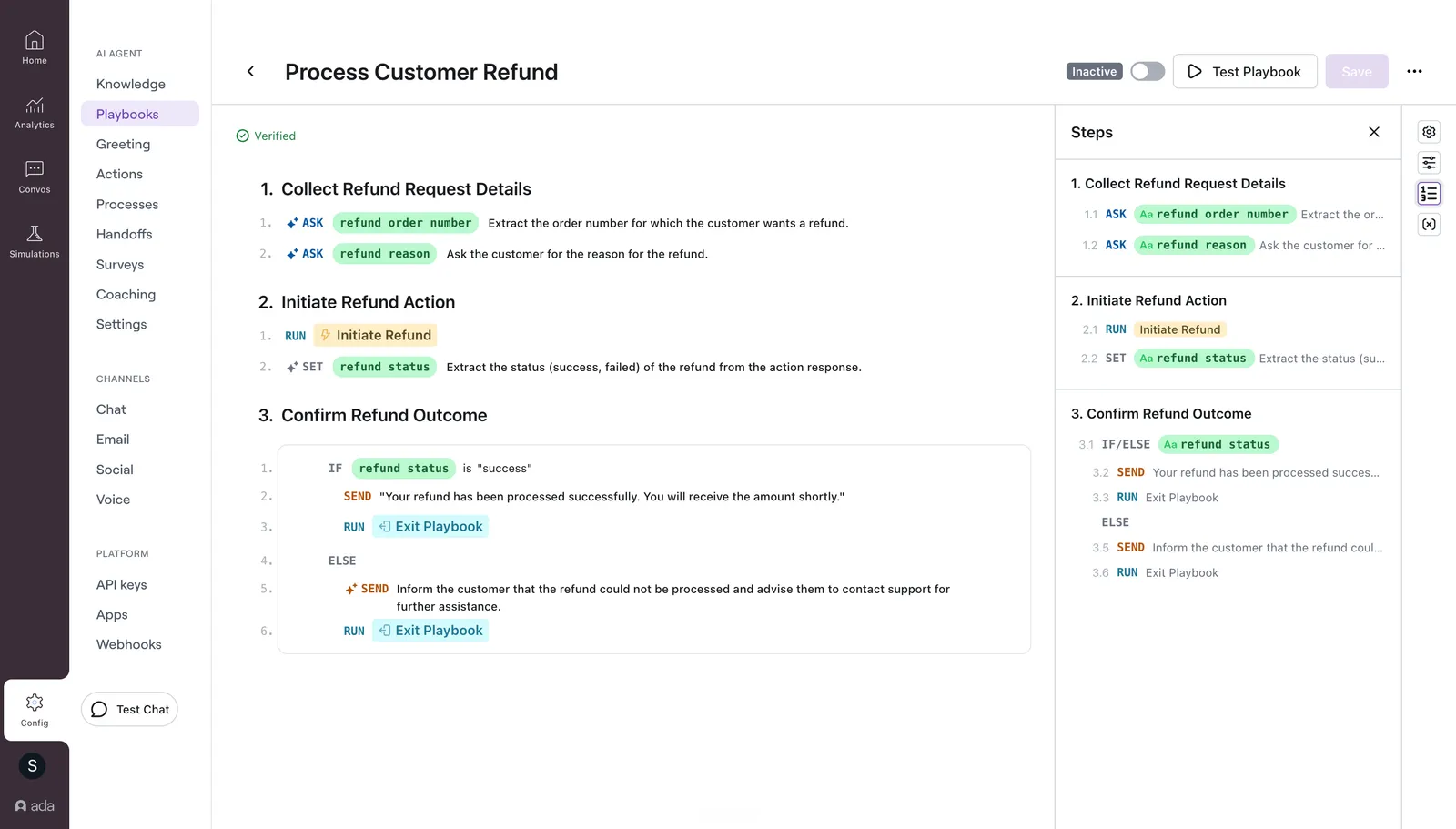
Playbooks build structured interactions from message, question, variable, API, branching and navigation steps. A refund flow can collect an order number, request data from a configured API and branch to a response or human handoff. These steps guide the interaction, but the agent can still change context or escalate. Current Playbooks are separate from Classic Playbooks and legacy Processes; new accounts created after June 2026 do not have Classic access.
API tools can retrieve data or change connected records, subject to configured authentication, user restrictions and subscription access. They are restricted to Playbooks or Processes by default, with independent use available as a setting. Python Code tools handle calculations and data transformations in a restricted sandbox, with network access limited to allowed domains. Ada also connects to MCP servers whose enabled tools become available to the agent.
MCP access has a useful distinction: a shared company credential reaches the same data for every conversation, while customer sign-in lets a tool act as the individual user. Customer-sign-in tools work on selected messaging connections and are skipped on voice, email and the Conversations API. They do not fall back to the company account on those channels. An integration that works in chat therefore may need a different approach for phone or email support.
Messaging and Email support 60 languages; Voice supports a smaller set. The dashboard and Playbook authoring are English-only, and Email conversations begin in English before customers switch by replying in another enabled language. Language tags alone do not keep regional content separate: Messaging and Email can use other locales in the same language when an exact locale has no article. Availability rules provide the regional restrictions.
Handoffs transfer conversations and context to configured human-support systems. Playbooks can be saved as inactive drafts or activated for customer interactions, with separate previews for an individual flow and the full agent. Ada's model-provider zero-retention arrangements are distinct from its own storage: residency, retention and deletion terms for the platform belong to the enterprise agreement.
Ada's standard commercial model bills each AI-agent conversation, including conversations that do not resolve the customer's request. Enterprise agreements can instead use resolution-based pricing. Rates, included volume and channel coverage are contract-specific, so a conversation allowance and a resolution allowance are different commercial units. Ada quotes rates and included usage for each deployment.
Best for
- Enterprise support teams serving messaging, email and voice
- Businesses with established help-centre content and service APIs
- Support operations needing multi-step automation and human escalation
Limitations
Ada requires a sales agreement and configured knowledge, tools and handoffs. Standard conversation billing can include unresolved requests. Voice and customer-sign-in MCP tools have narrower coverage than messaging, and the dashboard and Playbook authoring are English-only.
Ada features
Connected support knowledge
Use help-centre integrations, public web imports, authored articles or the Knowledge API. Activate articles and restrict availability by configured customer or region rules.
Scheduled website refresh
Refresh public website content daily, weekly or on demand. Imports read text, skip embedded media and currently assign the English language tag.
Step-based Playbooks
Build service flows with questions, variables, API calls and conditional branches. Current Playbooks have different access and linking rules from Classic Playbooks and legacy Processes.
API and Python tools
Connect service endpoints or transform data with sandboxed Python. API tools can read or change records; subscription access, authentication and usage settings apply.
MCP integrations
Enable tools from a connected server. Shared-account and customer-sign-in authentication reach different data; customer-sign-in tools are limited to supported messaging connections.
Multilingual customer service
Serve 60 languages in Messaging and Email, with a smaller Voice set. Regional article rules control content access beyond language and locale matching.
Human support handoff
Transfer a conversation and its context through a configured support integration. Escalation paths depend on the connected helpdesk, channel and routing settings.
Draft and live automation
Keep a Playbook inactive while editing, preview its flow and activate it for customers. Full-agent testing is available for active Playbooks.
Ada pricing
Ada uses sales-led pricing. Standard contracts bill every AI-agent conversation, whether or not it resolves the request; resolution-based enterprise pricing is also available. Rates, included usage and channel coverage depend on the agreement. Pricing model checked 10 October 2026.
Technical specifications
Customer support
| Feature | Ada |
|---|---|
| Agent or copilot workflow | Step-based Playbooks combine messages, inputs, variables, API calls and branches. Legacy Processes and Classic Playbooks are separate; tool integrations and human handoff extend the agent.Current step-based Playbooks; legacy access depends on account history |
| Support channels | Messaging, Email and Voice support current Playbooks. Messaging and Email support 60 languages; Voice has a subset. Customer-sign-in MCP tools have narrower channel coverage.Enabled channels and languages; MCP authentication restrictions |
| Knowledge grounding | Connected help centres, authored articles, public website imports and the Knowledge API. Web refresh is daily, weekly or on demand; web imports are tagged English. Article availability rules restrict customer or regional access.Source-specific authentication, import limits and availability settings |
| Human handoff | Configured Handoffs transfer conversations and context to human-support systems. Routing, channel and integration setup determine the transfer.Requires configured support integration and escalation route |
| Resolution and usage accounting | Standard pricing charges per AI-agent conversation, including unresolved requests. Resolution-based enterprise contracts are an alternative; rates and included volume are individually agreed.Sales-led agreement; conversation and resolution terms differ |
| API access | SupportedConfigured API tools, SDKs and integrations; subscription and access settings apply |
Ada alternatives
Other AI support products offer different helpdesk integrations and billing models.
Fin AI Agent
AI support and procedures with outcome-based billing and connected helpdesks.
Zendesk
A customer-service suite with human-agent tools and separately metered AI resolutions.
Forethought
Support automation that can connect to an existing customer-service platform.
Ada FAQs
What is Ada AI used for?
Ada automates customer-service conversations and tasks across configured messaging, email and voice channels. It can answer from connected knowledge, retrieve service data, run Playbooks and escalate to a human support team.
How much does Ada cost?
Ada uses sales-led contracts with rates and included volume agreed for the deployment. Standard pricing charges per AI-agent conversation; resolution-based enterprise agreements are an alternative. Rates and included usage depend on the agreement.
Does Ada bill conversations that are not resolved?
Yes, under its standard conversation-based model. Resolution-based enterprise agreements use separately agreed terms, so they should not be treated as the same billing unit.
Can Ada connect to an existing knowledge base?
Yes. Connections include Zendesk, Salesforce and Contentful, with a Knowledge API for custom integrations. Public website imports can sync daily, weekly or on demand, but they read text and currently tag imported articles as English.
Can Ada update accounts or orders?
Configured API and MCP tools can carry out service tasks, while Python Code tools can transform data or calculate values. Access depends on authentication, enabled tools, usage restrictions and subscription scope; it is not automatically read-only.
Do Ada MCP tools work on voice and email?
Shared-company-account tools can work across channels. Customer-sign-in MCP tools are limited to supported messaging connections and are skipped on voice, email and the Conversations API, with no fallback to the shared account.
How many languages does Ada support?
Messaging and Email support 60 languages, while Voice supports a subset. The dashboard and Playbook authoring remain English-only. Regional article restrictions require availability rules as well as language settings.
Can Ada hand a customer over to a person?
Yes. Handoffs move the conversation and relevant context to a configured human-support system. The integration, routing and escalation settings determine the transfer.
Is this your product? Claim this page to update your listing.